


From 2027, the Slovak Tax authority will require all VAT-registered companies based in Slovakia to send and receive structured invoices digitally for domestic B2B and B2G transactions. To transmit the invoice data, companies must use a certified service provider, such as Retarus.
A new development in Slovakia is that in addition to transmitting the actual invoice to the recipient, a special report now needs to be submitted to the Slovak tax authorities concurrently. The certified service provider is also responsible for handling this submission. However, the existing reporting methods will still be permitted in parallel until 2030 to smooth the transition.
Slovakia to introduce the Peppol 5-corner model
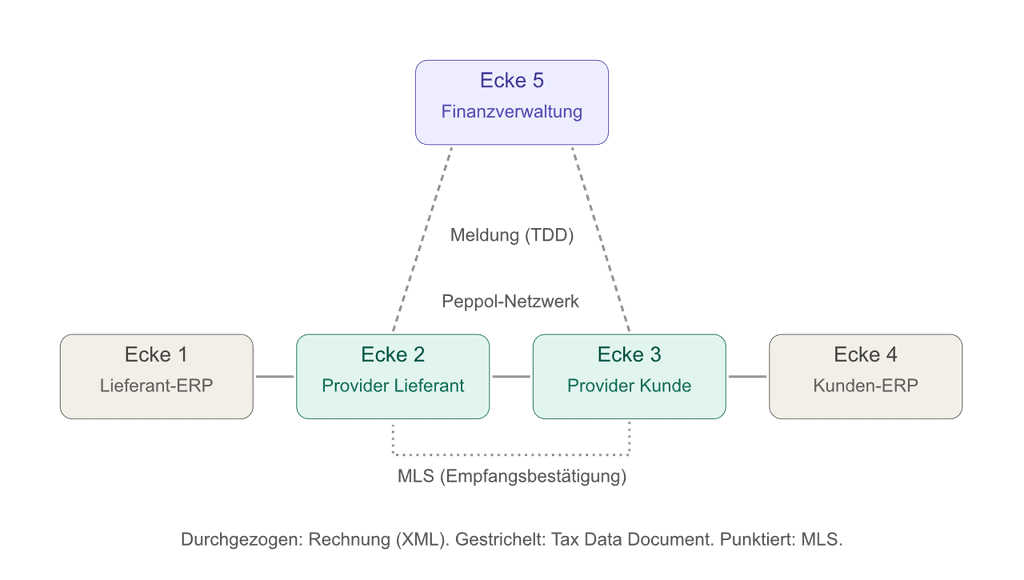
Slovakia is thus set to become the first country in Europe to extend the tried-and-tested Peppol 4-corner model into a 5-corner model. Peppol (short for Pan-European Public Procurement On-Line) is an international network for exchanging structured documents in the course of supply chain processes. A large number of countries have adopted the network as a technical platform for exchanging invoices in compliance with EN 16931.
According to the standard 4-corner model, the invoice is transmitted from the sender (1) via their Peppol service provider (2) to the recipient’s Peppol provider (3) and finally forwarded to the recipient (4). In the 5-corner model, however, the certified service provider is additionally required to transmit a “tax data document (TDD)” to the tax authority (5) in near real time. The TDD exclusively contains information which is strictly relevant to the tax authority.
Built-in technical document validation and acknowledgement of receipt
Using basic security functions, Peppol verifies that the exchanged invoices are technically valid and have indeed been delivered. Peppol service providers are contractually required to validate documents prior to sending them. Compliance with this contractual obligation, in turn, must be verified technically on the recipient’s side, after which receipt must be acknowledged by the recipient. To do this, the receiving service provider returns a “message level status (MLS)” to the sender. This facilitates error-handling processes. However, it’s important to bear in mind that technical validation does not involve any verification of the content itself!
What does this mean for your business?
Certifications, format requirements, integration with Peppol and government agencies, status updates, and ongoing changes in response to regulatory developments – if every company were to tackle all of these issues on its own, it would tie up valuable finance and IT resources which would then be lacking elsewhere.
On top of this, ERP integrations bring about huge dependencies on the release cycles and upgrade strategies of ERP vendors, whose main focus may be elsewhere.
As a certified third-party service provider, Retarus relieves you of this complexity, no matter which ERP landscape you are using. Your teams can continue working with their established processes, yet your invoices will remain fully compliant.
We are here to help you securely and seamlessly integrate new e-invoicing requirements into your European compliance roadmap, however many countries or formats are involved. Let us know how we can help.


Submit a comment